
So, you want to launch the next big Indian streetwear brand? Or maybe you’ve been tasked with printing 200 custom hoodies for your college festival cultural committee. You have the killer designs ready, your Instagram page layout looks fire, and you are all set to conquer the dhanda.
But then you hit a massive roadblock. You open a manufacturing website or walk into a local print shop in Tirupur, Surat, or Delhi, and the printer throws two technical acronyms at you: DTF (Direct to Film) and DTG (Direct to Garment).
To make matters worse, they start talking about variable ink loads, curing ovens, and multi-stage pre-treatment. Your brain is fried, and you are left asking the only question that actually matters to an Indian startup founder: “Bhai, cost kitna padega, aur profit kismein zyada hai?” (Brother, what will it cost, and which one makes more profit?)
If you’ve ever felt that your product profit margins are tighter than expected, the print method is often the hidden culprit. Choosing the wrong setup can destroy your budget before you sell a single piece.
Let’s do a completely transparent, zero-nonsense evaluation of DTF vs DTG printing cost in India so you can pick the option that gives you maximum value for your money.
🛠️ Decoding the Tech: What Exactly Are DTF and DTG?
Before jumping headfirst into the calculations, let’s understand what these machines are actually doing to your plain cotton or polyester t-shirt blanks.
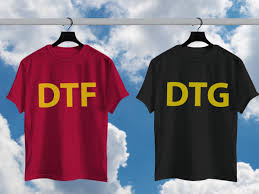
What is DTG (Direct to Garment)?
Think of a DTG printer as a giant, hyper-precise office inkjet printer, but instead of feeding it A4 sheets of paper, you slide a whole t-shirt onto a moving plate called a platen. The machine sprays specialized water-based pigment inks directly into the fabric structure.
Because the ink fuses directly into the threads, the print becomes an organic extension of the fabric. If you touch a premium DTG print, you will notice a “zero hand-feel” effect—meaning you can barely feel any rough ink layer on top. However, to make colors pop on dark fabrics, a chemical primer called pre-treatment must be sprayed onto the garment first.
What is DTF (Direct to Film)?
Direct to Film is a complete game-changer that has taken the Indian custom apparel industry by storm. Instead of printing directly onto the cloth, the machine prints your mirrored design onto a transparent PET transfer film.
While the ink is still wet, the film passes through an automated shaker machine that applies a uniform layer of hot-melt polymer powder (thermoplastic adhesive granules). This film is cured in a compact heat oven. Once ready, you take this transfer sheet, place it on any fabric, and clamp it down using a standard heat press machine for 15 seconds. You then peel the film back, leaving a vibrant, highly stretchable emblem fused firmly to the surface.
💰 The Per-Shirt Reality: DTF vs DTG Cost Per Print in India
Let’s look at real-world production conditions instead of vague theories. When running an online clothing label or custom print-on-demand (POD) hub through platforms like Printrove or Qikink, your final bill per garment is split into three main parts:
$$\text{Final Cost} = \text{Garment Blank Price} + \text{Printing Cost per Square Inch} + \text{GST (5\%) \& Shipping}$$
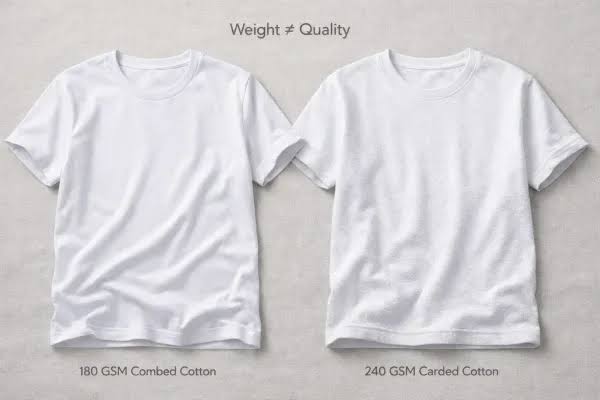
Let’s calculate the real numbers for a standard design using a mid-range 180 GSM to 240 GSM cotton blank costing roughly ₹160.
1. The DTF Cost Structure Breakdown
With DTF, your production cost per print is beautifully predictable. Because the ink is applied to a standard film sheet first, it doesn’t matter if your design is light or dark. The printing charges remain uniform across different garment bases.
In India, leading custom fulfillment vendors charge roughly ₹0.75 to ₹0.90 per square inch for a standard DTF run.
- Left Pocket Logo (4″ x 4″): $16 \text{ sq inches} \times ₹0.75 = ₹12$ (Minimum vendor baseline charges usually set this at a flat ₹50 to ₹80).
- Full Standard Front/Back Graphic (10″ x 10″): $100 \text{ sq inches} \times ₹0.75 = ₹75$.
- Massive Streetwear Oversized Graphic (14″ x 16″): $224 \text{ sq inches} \times ₹0.75 = ₹168$.
2. The DTG Cost Structure Breakdown
DTG is a completely different beast. Your ink usage varies wildly based on design complexity and base color. On a white t-shirt, the process is cheap because you don’t need a white ink underbase. But if you print the exact same design on a black or navy blue shirt, the printer has to run a heavy pass of white ink first so your colors don’t look muddy or invisible.
- White T-Shirt Base Printing: Roughly ₹0.50 per square inch.
- Dark/Black T-Shirt Base Printing: Jumps to ₹0.75 to ₹0.95 per square inch due to mandatory pre-treatment spray and double ink passes.
This means a massive 14″ x 16″ back graphic on a black streetwear hoodie can easily cost you ₹170 to ₹230 for the print alone via DTG!
📊 Side-by-Side Financial Comparison Matrix
To give you an immediate bird’s-eye view of how these numbers impact your wallet, let’s look at how the tech holds up across various critical business metrics:
| Operational Feature | DTF Printing System | DTG Printing System |
| Average Cost Per Print (A4 Size) | ₹60 – ₹90 (Highly consistent) | ₹80 – ₹140 (Depends heavily on ink use) |
| Fabric Compatibility | Cotton, Polyester, Nylon, Blends | Strictly 100% Cotton / High-cotton blends |
| Minimum Vendor Order (MOQ) | No Minimum (1 piece welcome) | No Minimum (But single dark runs are pricey) |
| Color Saturation | Ultra-vibrant, bright whites | Matte finish, deep artistic look |
| Production Speed | High (Prints transfers in continuous rolls) | Slower (Requires loading individual shirts) |
| Risk of Failed Prints | Low (If a print fails, you only waste film) | High (A printing error ruins the entire shirt) |
🔍 Initial Setup Investment: Buying In-House Machinery in India
If you want to move past outsourcing and install your own production setup to maximize your long-term DTF vs DTG printing cost in India margins, the capital investment numbers vary wildly.
[In-House Setup Cost in India]
 ├── DTF Setup (Entry to Mid-tier): ₹1.3 Lakh to ₹3.5 Lakh
 │    └── Converted L1800/XP600 Dual Head + Manual Oven + Heat Press
 └── DTG Setup (Industrial Baseline): ₹12 Lakh to ₹45 Lakh+
      └── Epson SC-F2130 / Brother GTX / Kornit Systems + Pre-treatment Machine
The Budget-Friendly Route: DTF Machine Costs
You can start a small home-based or garage-scale DTF workshop with a surprisingly modest budget. Converted desktop setups (like an updated Epson L1800 platform) or dedicated 12-inch single-head roll printers cost between ₹1.35,000 to ₹1,65,000.
If you want to step up to high-speed dual-head commercial printers (like the Epson i3200 or XP600 models paired with automatic powder shakers), the investment scales to ₹2.6 Lakh to ₹5.9 Lakh.
The Enterprise Route: DTG Machine Costs
DTG machinery requires serious financial backing. Brand-new industrial workhorses from international giants like Brother, Epson, or Kornit start at ₹12 Lakh and can easily cross ₹35 Lakh for automated, continuous multi-platen systems.
Furthermore, you can’t leave a DTG machine sitting idle. If you don’t use it daily, the high-density white ink will clog the advanced printheads, landing you a repair bill that could easily cost over ₹50,000.
🎨 Beyond the Price Tag: Look, Feel, and Wash-Fastness
In the premium fashion landscape, choosing a print method isn’t just about cutting production costs. It’s about maintaining a standard that keeps your customers from leaving negative reviews on your website.
1. Print Aesthetics and Hand-Feel
This is where DTG claws its way back into the competition. Because the water-based ink integrates directly into the fabric structure, the garment remains light, breezy, and completely breathable. It is the absolute benchmark choice for luxury street fashion houses, premium organic lifestyle wear, and heavy oversized drop-shoulder drops where comfort is everything.
DTF doesn’t sink into the fabric. Instead, it creates a microscopic, highly elastic polymer sheet that sits on top of the fabric surface. Thanks to modern Japanese ink sets and high-end TPU adhesive powders, modern DTF does not feel like a stiff sheet of plastic. It feels soft and supple, but you can feel it if you run your hand over the graphic. On a scorching summer afternoon in Mumbai or Delhi, a massive DTF back-print can feel a bit sweaty because it blocks the fabric’s natural airflow.
2. Durability and Wash-Fastness
When it comes to surviving the rough spin cycles of typical Indian top-load washing machines, DTF outlasts DTG by a wide margin.
[Wash-Fastness & Longevity Breakdown]

DTG Printing:
  ████████████████████ (20-30 Washes: Starts looking vintage/faded)

DTF Printing:
  ██████████████████████████████████████ (50+ Washes: Maintains sharp vibrancy)
DTG prints can begin to look slightly weathered or “vintage” after 20 to 30 deep washes as the cotton fibers split over time. DTF transfers, however, hold their sharp edges and bright colors for more than 50 wash cycles without peeling or cracking, provided they were correctly cured at 160°C during production.
🚀 The Strategic Verdict: Which Method Should You Choose?
Now that all the numbers are out on the table, let’s simplify your business decision based on your current operational scale and product focus.
You should choose DTF printing if:
- You are running on a tight budget: You are launching your brand using a lean print-on-demand dropshipping model and need stable, predictable margins.
- You sell diverse products: Your store features multi-fabric options like polyester sports jerseys, heavy fleece hoodies, canvas tote bags, and cotton tees.
- Vibrant graphics are your main selling point: Your designs feature bold anime graphics, multi-colored vector illustrations, or high-contrast street art that needs to pop dramatically against pitch-black cloth.
You should choose DTG printing if:
- You are building an uncompromising luxury line: Your entire brand is built around 100% premium combed ring-spun cotton and a soft, breathable hand-feel.
- You feature high-detail photographic artwork: Your catalog focuses on fine-art designs, complex oil-painting reproductions, or smoky grayscale graphics that require flawless gradients.
- You already have a steady high-volume flow: You run an established e-commerce platform with enough consistent daily orders to justify expensive machinery maintenance.
📈 Real-Life Profit Margin Blueprint
To tie it all together, let’s look at a realistic profit projection for a young apparel store in India selling via Instagram or Shopify.
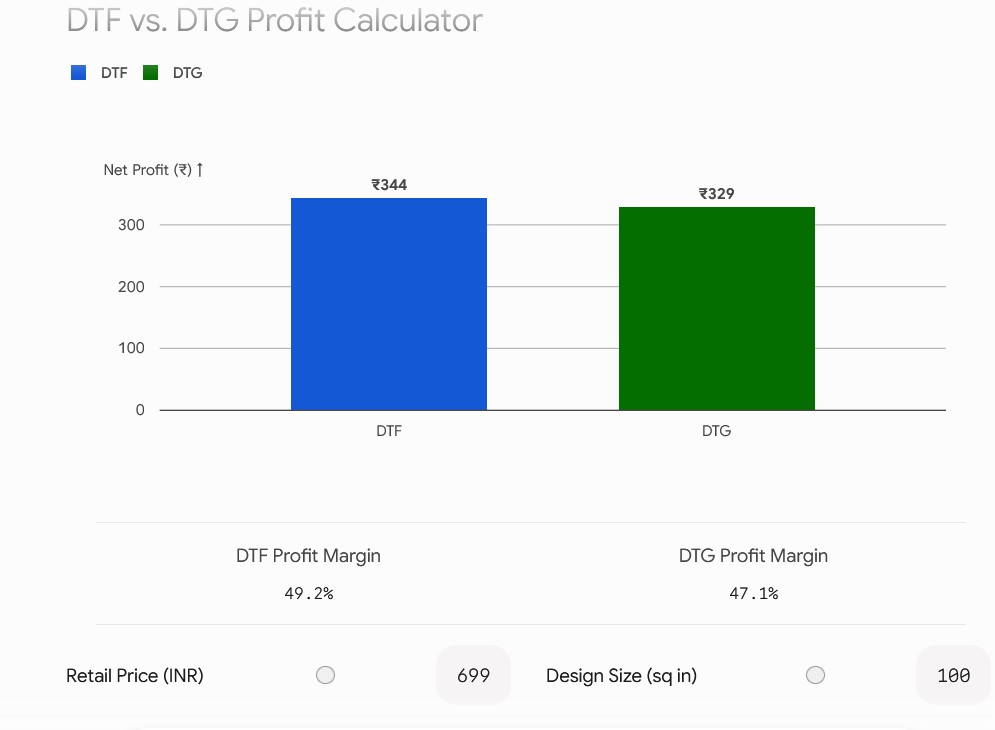
Imagine you sell a trendy oversized graphic t-shirt for ₹699 (a standard price tier for Indian Gen-Z buyers). Let’s see how much actual money stays in your bank account after paying production fees:
At the end of the day, building a successful custom apparel business isn’t just about chasing the cheapest printing method. It’s about knowing where your money goes.
If you are just starting your brand journey, DTF offers a low-risk, highly predictable cost structure that lets you test different design ideas without blowing your budget. Once your brand grows and your audience demands a premium feel, you can reinvest your profits into high-end DTG production runs.
At the end of the day, building a successful custom apparel business isn’t just about chasing the cheapest printing method. It’s about knowing where your money goes.
If you are just starting your brand journey, DTF offers a low-risk, highly predictable cost structure that lets you test different design ideas without blowing your budget. Once your brand grows and your audience demands a premium feel, you can reinvest your profits into high-end DTG production runs.
See Also
DTG vs DTF: Which is Best for Your Printing Business?
Elevate Your Style: The Ultimate Guide to Customized Polo T-Shirts