
You have a design, a manufacturer’s number and perhaps even a few interested buyers. Then the quotations arrive: ₹190 from one supplier, ₹250 from another and ₹340 from someone promising “export quality”.
Which quotation is correct?
Possibly all three.
The final T-shirt cost per piece depends on fabric, GSM, size ratio, stitching quality, printing method, quantity, wastage, packaging and delivery. That is why every clothing brand, corporate buyer and merchandise seller should understand the t shirt costing formula India manufacturers use before approving an order.
This guide explains the complete garment costing formula in plain language. It also includes worked examples for 50, 100 and 500 printed T-shirts and a downloadable Excel costing calculator.
Pricing note: All figures below are planning examples, not fixed supplier rates. Public Indian pricing pages show printing-only charges varying widely by printing method, design size and quantity. Fabric quotations also change according to GSM, yarn, finish and minimum order quantity. Always obtain a fresh written quotation for your exact specification. (Qikink)
How Is the Cost of a T-Shirt Calculated?
A T-shirt is costed by adding fabric, cutting, stitching, printing, trims, packaging, wastage, overheads and logistics. The total is then divided by the number of saleable pieces.

Fixed charges such as screen preparation, sampling, embroidery digitisation and transport must also be spread across the order.
Download Makemyt-shirt Costing Formula
Master T-Shirt Costing Formula
T-shirt cost per piece = Fabric + cutting + stitching + printing + trims + packaging + wastage + overheads + shipping
For a more accurate t shirt costing formula India businesses can use in Excel:
Cost per saleable piece = Variable cost per piece + (Total fixed order costs ÷ Saleable quantity) + Wastage allowance
Use saleable quantity, not simply ordered quantity. If you order 100 T-shirts but only 97 pass inspection, divide the total expense by 97.
That small adjustment can reveal why your real T-shirt cost per piece is higher than the supplier’s basic production rate.
Complete Garment Costing Formula for Printed T-Shirts
A factory may quote one final amount, but you should know what sits behind it.
Fabric Cost and T-Shirt GSM
Fabric is generally the largest part of the T-shirt manufacturing cost. Its price changes with:
- Cotton, cotton-polyester, dry-fit polyester or cotton Lycra
- Carded, combed or compact-combed yarn
- Fabric GSM
- Dyeing and finishing
- Regular, oversized or drop-shoulder fit
- Garment colour
- Size ratio within the order
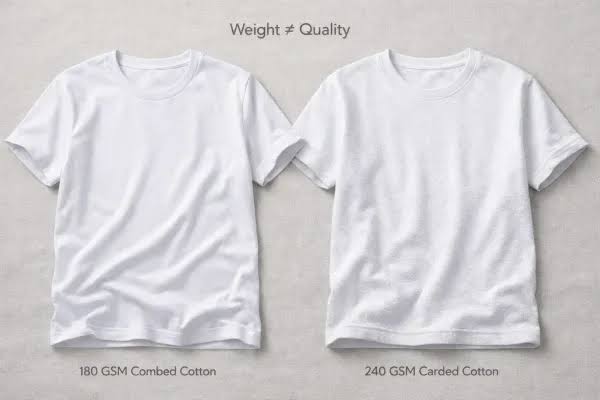
A 240 GSM oversized T-shirt consumes more fabric than a 160 GSM regular-fit tee. An order containing many XXL and XXXL sizes will also consume more fabric than one dominated by S, M and L sizes.
Do not compare two quotations only by asking whether both suppliers are using “cotton”. Ask for the fibre composition, yarn type, GSM, finish and expected shrinkage.
Cutting Charges
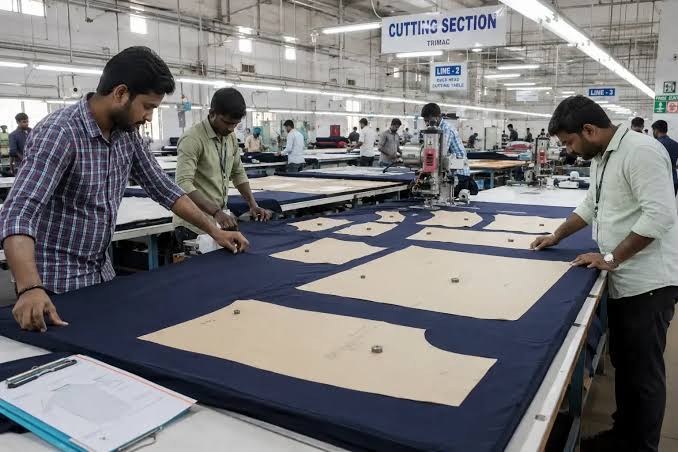
Cutting includes:
- Spreading the fabric
- Arranging the marker
- Cutting the garment panels
- Separating sizes
- Numbering and bundling the pieces
The cutting charge per piece often falls at higher quantities because more fabric layers can be processed together.
Patterns with pockets, contrast panels or unusual shapes can increase cutting time and fabric loss.
Stitching or CMT Cost
CMT means cut, make and trim.
Some suppliers include cutting and basic sewing thread in the CMT rate. Others quote stitching separately. Confirm exactly what is included before comparing rates.
Stitching becomes more expensive when the T-shirt has:
- Drop shoulders
- Contrast panels
- Pockets
- Side slits
- Ribbed cuffs
- Heavy neck rib
- Cover-stitch detailing
- Shoulder taping
- Reinforced seams
A standard promotional T-shirt will therefore have a lower stitching cost than a premium oversized streetwear T-shirt.
Printed T-Shirt Cost Calculation
Printing cost depends on:
- Printing method
- Artwork dimensions
- Number of colours
- Number of print placements
- Garment colour
- Ink coverage
- Order quantity
A small left-chest logo is not priced like a full-back graphic.
Always specify print dimensions in inches or centimetres. Avoid descriptions such as “small design” or “medium print”, because different printers may interpret them differently.
Labels and Garment Trims
Labels and trims may include:
- Main brand label
- Size label
- Wash-care label
- MRP tag
- Hang tag and string
- Neck tape
- Barcode sticker
- Woven patch
- Security or authenticity label
A plain corporate T-shirt may need only a size label. A retail clothing brand may require four or five separate trims.
T-Shirt Packaging Cost
Packaging may include:
- Individual transparent polybag
- Size sticker
- Tissue paper
- Thank-you card
- Branded mailer
- Barcode label
- Master carton
- Protective wrapping for transport
A ₹7 or ₹8 packaging expense may look insignificant, but it becomes ₹4,000 at 500 pieces.
The packaging used for bulk corporate supply can also be very different from packaging designed for a D2C fashion brand.
Wastage and Production Rejections
Loss can occur during:
- Fabric inspection
- Shade segregation
- Cutting
- Printing
- Sewing
- Washing
- Finishing
- Final quality inspection
A practical planning allowance for a simple style is often around 3% to 7%. Consider a higher allowance for an untested pattern, difficult placement print, unfamiliar fabric or strict inspection standard.
Do not add the same wastage twice.
When your fabric consumption already includes cutting loss, add only the remaining allowance for printing, sewing and finished-garment rejection.
Factory and Business Overheads
Overheads are expenses that do not physically appear inside the T-shirt but are still necessary to produce and sell it.
They may include:
- Electricity
- Factory rent
- Sampling
- Quality control
- Supervision
- Administration
- Machine maintenance
- Design preparation
- Payment charges
- Product photography
- Warehousing
Small businesses often calculate only what they pay the factory and forget their own operating expenses.
That can make an order look profitable on paper even when very little money remains after the sale.
Shipping and Logistics
Keep the following costs separate:
- Inward freight: Fabric, trims and packaging sent to the factory
- Bulk outward freight: Finished T-shirts sent to your warehouse
- Customer delivery: Individual order sent to the buyer
- Return freight: Exchange, failed delivery or return-to-origin expense
An ex-factory quotation may not include delivery to your warehouse.
Ask suppliers to clearly state whether their price is ex-factory, delivered or inclusive of packing and transport.
Taxes
Calculate production profitability before GST. Add the applicable tax when preparing the invoice.
Under the GST changes recommended by the 56th GST Council for implementation from 22 September 2025, apparel under Chapters 61 and 62 with a sale value not exceeding ₹2,500 per piece was placed at 5%. Apparel above ₹2,500 per piece was placed at 18%.
Confirm the latest notification and HSN treatment with your accountant before invoicing. (Goods & Services Tax Council)
How to Calculate Fabric Cost per T-Shirt
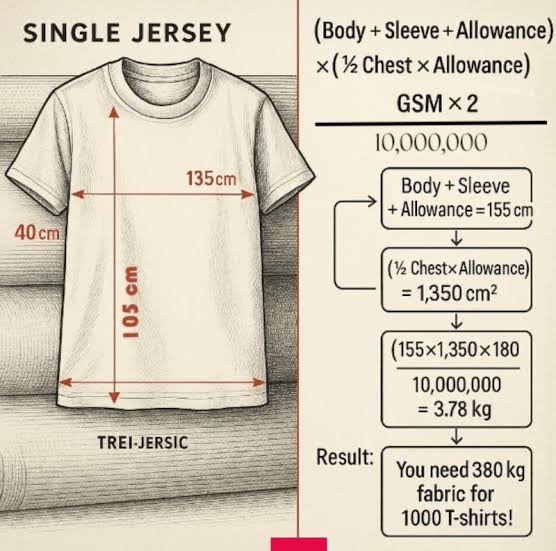
Fabric consumption is the heart of the t shirt costing formula India manufacturers use.
There are two practical ways to calculate it.
Method 1: Fabric Price per Kilogram
When knitted fabric is quoted by weight, use:
Fabric cost per T-shirt = Fabric price per kg ÷ Number of T-shirts produced per kg
Suppose 180 GSM cotton fabric costs ₹440 per kg and the actual cutting yield is four T-shirts per kg.
Base fabric cost:
₹440 ÷ 4 = ₹110 per T-shirt
Now add 5% cutting wastage:
₹110 × 5% = ₹5.50
Fabric cost including wastage:
₹110 + ₹5.50 = ₹115.50 per T-shirt
Do not assume that one kilogram will always produce four garments. The actual yield changes according to:
- GSM
- Pattern dimensions
- Fabric width
- Size ratio
- Sleeve length
- Regular or oversized fit
- Cutting efficiency
Ask the manufacturer for marker consumption based on your actual pattern.
Method 2: Finished Garment Weight
When you know the average weight of one T-shirt:
Fabric requirement in kg = Average garment weight in grams × Quantity ÷ 1,000
Suppose one finished T-shirt weighs an average of 190 grams.
For 100 T-shirts:
190 × 100 ÷ 1,000 = 19 kg
With 5% wastage:
19 × 1.05 = 19.95 kg
At ₹440 per kg:
19.95 × ₹440 = ₹8,778 total fabric cost
Fabric cost per ordered piece:
₹8,778 ÷ 100 = ₹87.78
Remember that the garment weight method should be based on an approved sample. A supplier’s rough estimate may not accurately represent your final pattern.
Why the Size Ratio Changes Fabric Cost
“100 pieces” is not enough information for proper costing. The supplier also needs the number required in each size.
For example:
- 10 Small
- 30 Medium
- 35 Large
- 20 XL
- 5 XXL
This order will consume less fabric than another 100-piece order dominated by XL, XXL and XXXL.
Include the complete size breakup whenever you request a quotation.
T-Shirt Printing Cost by Method
The printing line in your t shirt costing formula India worksheet should be calculated carefully rather than entered as one random amount.
Screen Printing Cost for Bulk Orders
Screen printing works well for:
- Repeated artwork
- Solid colours
- Corporate logos
- College merchandise
- Event T-shirts
- Medium and large orders
Each colour may require a separate screen. A one-colour logo will therefore be cheaper than a six-colour illustration.
Use this formula:
Screen printing cost per piece = Running print charge + (Screen and setup cost ÷ Saleable quantity)
Suppose screen preparation costs ₹800 and the running print charge is ₹14 per garment.
For 50 pieces:
₹14 + ₹800 ÷ 50 = ₹30 per piece
For 100 pieces:
₹14 + ₹800 ÷ 100 = ₹22 per piece
For 500 pieces:
₹14 + ₹800 ÷ 500 = ₹15.60 per piece
This explains why screen printing becomes more economical as quantity increases.
DTF Printing Cost
Direct-to-film printing is useful for:
- Multicolour artwork
- Gradients
- Detailed illustrations
- Short production runs
- Testing a new design
DTF pricing is normally linked to design dimensions or transfer-sheet area.
It can be suitable for orders of 20 to 100 pieces because it does not require separate screens for every colour. However, a large front-and-back print may still be expensive.
DTG Printing Cost
Direct-to-garment printing suits detailed artwork, colour transitions and short runs.
The rate depends on:
- Garment colour
- Pretreatment
- White-ink requirement
- Print dimensions
- Ink coverage
- Machine time
Dark T-shirts generally require additional white ink and preparation.
DTG is commonly considered for samples, limited editions and print-on-demand orders rather than conventional large-volume production.
Embroidery Cost
Embroidery pricing is based mainly on:
- Stitch count
- Design dimensions
- Thread colours
- Placement
- Fabric stability
- Order quantity
A small left-chest logo may be affordable. A dense, oversized embroidered design can become one of the costliest embellishment options.
Also include digitisation charges. Digitisation is a fixed setup expense and should be divided across the saleable order quantity.
Worked T-Shirt Costing Examples for 50, 100 and 500 Pieces
Let us apply the t shirt costing formula India to one basic specification:
- 180 GSM combed cotton
- Regular round-neck fit
- One front print
- Standard labels
- Individual polybag
- Bulk delivery to one city
- 5% wastage allowance
- Prices before GST
T-Shirt Cost Per Piece Comparison
| Cost component | 50 pieces | 100 pieces | 500 pieces |
|---|---|---|---|
| Fabric | ₹105 | ₹100 | ₹92 |
| Cutting | ₹12 | ₹10 | ₹8 |
| Stitching | ₹42 | ₹38 | ₹32 |
| Printing | ₹32 | ₹22 | ₹14 |
| Labels and trims | ₹10 | ₹9 | ₹8 |
| Packaging | ₹9 | ₹8 | ₹7 |
| Manufacturing subtotal | ₹210 | ₹187 | ₹161 |
| Wastage at 5% | ₹10.50 | ₹9.35 | ₹8.05 |
| Overheads | ₹15 | ₹12 | ₹9 |
| Bulk shipping | ₹10 | ₹7 | ₹4 |
| Estimated cost per piece | ₹245.50 | ₹215.35 | ₹182.05 |
| Estimated order cost | ₹12,275 | ₹21,535 | ₹91,025 |
The price falls with quantity because:
- Fabric procurement becomes more efficient
- Printing setup is spread across more garments
- Production planning takes similar effort
- Cutting and stitching productivity improves
- Freight is divided by more pieces
Costing for 50 T-Shirts
Estimated T-shirt cost per piece: ₹245.50
With a 30% wholesale markup:
₹245.50 × 1.30 = ₹319.15
A practical quotation may be ₹320 per piece before GST.
Estimated order value:
₹320 × 50 = ₹16,000 before GST
Costing for 100 T-Shirts
Estimated T-shirt cost per piece: ₹215.35
With a 30% markup:
₹215.35 × 1.30 = ₹279.96
A practical quotation may be ₹280 per piece before GST.
Estimated order value:
₹280 × 100 = ₹28,000 before GST
Costing for 500 T-Shirts
Estimated T-shirt cost per piece: ₹182.05
With a 30% markup:
₹182.05 × 1.30 = ₹236.67
A practical quotation may be ₹237 or ₹240 per piece before GST, depending on payment terms, inspection requirements and delivery risk.
Estimated order value at ₹240:
₹240 × 500 = ₹1,20,000 before GST
The exact figures will change, but this is how a reliable t shirt costing formula India turns supplier inputs into a defensible price.
How to Add Wholesale and Retail Margins
Markup and margin are not the same.
This distinction is extremely important when calculating the final selling price.
Wholesale Markup Formula
Selling price = Cost × (1 + Markup percentage)
Suppose a T-shirt costs ₹200 and you add a 40% markup:
₹200 × 1.40 = ₹280
Your profit is ₹80.
However, your gross margin is not 40%. It is:
₹80 ÷ ₹280 × 100 = 28.6%
Retail Gross-Margin Formula
Selling price = Cost ÷ (1 − Target gross margin)
Suppose the T-shirt costs ₹200 and you want a 40% gross margin:
₹200 ÷ 0.60 = ₹333.33
Your selling price should therefore be approximately ₹334 before GST and other customer-level expenses.
Extra Costs in Retail T-Shirt Pricing
A retail clothing brand may also need to recover:
- Marketplace commission
- Payment gateway charges
- Advertising expenses
- Customer shipping subsidy
- Cash-on-delivery fees
- Returns and exchanges
- Warehousing
- Discount coupons
- Product photography
- Unsold inventory
A T-shirt that costs ₹200 to manufacture cannot automatically be sold profitably at ₹299.
Calculate the complete customer-delivered cost before setting the MRP.
Common T-Shirt Costing Mistakes
Quoting Before Fixing the Specification
“Cotton round-neck T-shirt with print” is not a complete specification.
Mention:
- Fabric composition
- GSM
- Yarn type
- Fit
- Colour
- Size ratio
- Printing method
- Artwork dimensions
- Print placements
- Labels
- Packaging
Without these details, quotations from different suppliers cannot be compared fairly.
Dividing Cost by Ordered Quantity
Divide the total expense by expected saleable pieces after rejects.
This adjustment makes the t shirt costing formula India far more accurate.
Ignoring Fixed Setup Charges
Ask whether the quotation includes:
- Screens
- Sampling
- Colour separation
- Embroidery digitisation
- Test printing
- Pattern development
- Courier charges for samples
A low per-piece rate may hide substantial setup expenses.
Comparing T-Shirts Only by GSM
Two suppliers may both quote 180 GSM cotton but use different yarn, knitting, dyeing and finishing quality.
Compare the complete fabric specification, not only GSM.
Forgetting XXL and Plus-Size Surcharges
Some manufacturers add extra charges above XL because larger sizes consume more fabric.
Confirm whether one rate applies to every size or whether XXL and XXXL carry a surcharge.
Mixing GST-Inclusive and GST-Exclusive Quotations
A quotation of ₹210 plus GST is not the same as ₹210 inclusive of GST.
Ask the supplier to show:
- Basic product value
- GST
- Transport
- Setup charges
- Final payable amount
Mixing Manufacturing and Customer Delivery Costs
Track these as separate numbers:
- Ex-factory manufacturing cost
- Warehouse landed cost
- Customer-delivered cost
This makes both wholesale and e-commerce pricing easier to manage.
Downloadable T-Shirt Costing Sheet
Use the accompanying T-Shirt Costing Formula India Excel Calculator to enter:
- Ordered and saleable quantities
- Fabric price per kilogram
- Garment yield per kilogram
- Cutting wastage
- Cutting and stitching charges
- Printing rate
- Printing setup cost
- Labels, trims and packaging
- Fixed and variable overheads
- Inward and outward freight
- Wholesale markup
- Retail gross-margin target
- Applicable GST rate
The calculator automatically works out:
- Fabric cost per T-shirt
- Wastage cost
- Printing setup cost per piece
- Fixed overhead per piece
- Production cost
- Landed cost
- Wholesale selling price
- Retail price
- Gross profit
- Total order expense
Replace every sample input with a written supplier quotation.
The sheet supports decision-making, but it does not replace a proper tech pack, approved sample, purchase order or quality agreement.
Frequently Asked Questions
How Much Does It Cost to Manufacture One T-Shirt in India?
A basic printed T-shirt may be planned at approximately ₹150 to ₹300 per piece in commercial quantities.
Small orders, heavyweight fabrics, oversized patterns, premium finishing, multiple print placements and complex artwork can cost considerably more.
The final T-shirt manufacturing cost must be calculated from the actual specification and quantity.
Why Do Small T-Shirt Orders Cost More?
Small orders cost more because sampling, screen preparation, transport, supervision and production planning are spread across fewer pieces.
Suppliers may also be unable to purchase fabric, labels and packaging at their best bulk rates.
What Percentage Should Be Added for Wastage?
A 3% to 7% allowance is a useful starting point for a simple, repeatable style.
Consider a higher allowance for:
- New patterns
- Difficult print placements
- Strict shade matching
- Complex stitching
- Unfamiliar fabrics
- Very strict quality inspections
Track cutting wastage and rejected finished garments separately.
How Is Printing Cost per Piece Calculated?
Use:
Printing cost per piece = Running printing charge + Fixed setup charge ÷ Saleable quantity
When the design has multiple placements, calculate the front, back, sleeve and neck prints separately.
What Is the Difference Between Manufacturing Cost and Landed Cost?
Manufacturing cost covers making the T-shirt.
Landed cost adds expenses required to bring the finished garment to your warehouse, including packaging, inspection and freight.
Customer-delivered cost goes further and includes last-mile delivery, selling fees, returns and payment charges.
Is GSM Enough to Compare T-Shirt Quality?
No.
GSM measures fabric weight. It does not fully describe quality.
Yarn type, fibre composition, knitting, dyeing, shrinkage control, colour fastness, finishing and garment construction also affect performance and price.
Should GST Be Included in the Manufacturing Cost?
Keep GST separate when analysing production profitability, especially when input tax credit applies to the business.
Calculate the pre-GST cost and selling price first. Then apply the appropriate GST rate to the invoice after confirming the HSN classification.
Final Takeaway
A dependable t shirt costing formula India brands can use is straightforward:
- Calculate fabric consumption.
- Add cutting and stitching.
- Add printing and setup costs.
- Include labels, trims and packaging.
- Allow for wastage and rejections.
- Add overheads and logistics.
- Divide fixed expenses by saleable quantity.
- Apply the correct markup or gross-margin formula.
Once you follow this method, supplier quotations stop looking like random numbers.
You can compare manufacturers fairly, negotiate using actual figures and choose a selling price that protects both product quality and business profit.
See Also
Costing Procedure for Men’s Basic T-Shirts
Basic Tee Shirt Costing
WOVEN SHIRT COSTING – PART 1
Oversized Drop Shoulder T Shirt Size Chart: The Structural Silhouette Guide for Indian Streetwear Fits
Navigating the Textile Capital: How to Buy Fabric in Bulk From Tirupur Wholesale Market
Blinkstore vs Qikink Print on Demand India: The Inventory-Free Gateway