
Introduction: Why T-Shirt GSM Confuses So Many Buyers
Buying a t-shirt online sounds simple until you see words like 180 GSM cotton, 240 GSM oversized tee, heavyweight fabric, premium drop shoulder fit, or luxury streetwear blank.
Suddenly, it becomes confusing.
You may think a thicker t-shirt is always better. But then it arrives, and it feels too heavy for Indian summer. Or you buy a lighter t-shirt thinking it will be comfortable, but it feels too thin, clingy, or not premium enough.
This is exactly why understanding the difference between 180 gsm and 240 gsm t shirt matters.
For regular buyers, GSM helps you understand how a t-shirt may feel on the body. For clothing brands, creators, D2C founders, wholesalers and print-on-demand sellers, GSM can decide whether your product feels budget, everyday, premium, or streetwear-style.
But here is the most important thing: GSM does not directly mean quality.
A 180 GSM t-shirt can be excellent if the cotton, knitting, stitching and finishing are good. A 240 GSM t-shirt can feel uncomfortable if the fabric is poorly knitted or badly finished.
So, instead of asking “Which GSM is best?”, the smarter question is:
Which GSM is best for my purpose, climate, fit and customer?
In this blog, we will break down the difference between 180 gsm and 240 gsm t shirt in simple, practical language, especially for Indian buyers and clothing businesses.
What is GSM in T-Shirt Fabric?
GSM stands for Grams per Square Meter.
It tells you how much one square meter of fabric weighs in grams.
So, if a fabric is 180 GSM, it means one square meter of that fabric weighs 180 grams. If a fabric is 240 GSM, one square meter weighs 240 grams.
Simple, right?
But here is where people get confused. GSM does not mean the full t-shirt weighs 180 grams or 240 grams. The actual weight of the t-shirt depends on many things:
- Size of the t-shirt
- Fabric width
- Pattern cutting
- Sleeve length
- Rib quality
- Neck finishing
- Oversized or regular fit
- Printing or embroidery
- Fabric composition
A 240 GSM oversized t-shirt in XL will obviously feel much heavier than a 180 GSM regular-fit t-shirt in medium size.
That is why GSM is best understood as fabric density, not final garment weight.
The Technical Specs: Mathematics of GSM Explained Simply
Let’s understand the basic maths.
If a fabric sample of 1 square meter weighs 180 grams, it is called 180 GSM fabric.
If a fabric sample of 1 square meter weighs 240 grams, it is called 240 GSM fabric.
The difference is:
240 GSM – 180 GSM = 60 GSM
That means a 240 GSM t-shirt fabric is roughly 33% heavier per square meter than a 180 GSM fabric.
This 33% difference may not sound huge on paper, but on the body, it can feel very different.
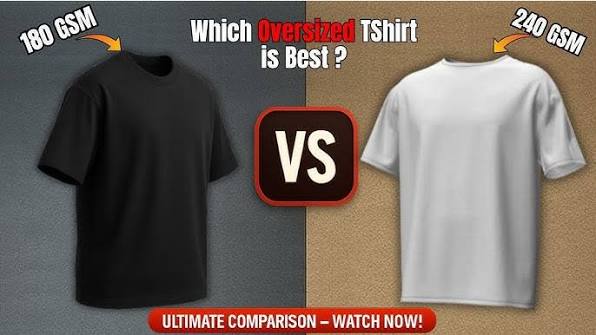
A 180 GSM t-shirt usually feels:
- Lighter
- More breathable
- Easier for daily wear
- Better for Indian summers
- Suitable for casual round-neck t-shirts
A 240 GSM t-shirt usually feels:
- Thicker
- Heavier
- More structured
- Better for oversized streetwear
- More premium in hand-feel
So, the difference between 180 gsm and 240 gsm t shirt is not only about thickness. It is about comfort, drape, fit, climate, styling and customer expectation.
180 GSM vs 240 GSM T-Shirt: Quick Comparison Table
| Feature | 180 GSM T-Shirt | 240 GSM T-Shirt |
|---|---|---|
| Fabric Feel | Medium-light | Heavyweight |
| Best For | Daily casual wear | Streetwear and premium drops |
| Indian Summer Comfort | Very good | Can feel warm |
| Drape | Falls naturally | Holds shape better |
| Fit Type | Regular, slim, casual | Oversized, boxy, drop shoulder |
| Printing Suitability | Good for normal prints | Better for premium prints and embroidery |
| Breathability | Better | Lower than 180 GSM |
| Perceived Premium Feel | Good | Very premium |
| Best Buyer | Daily wear customer | Fashion/streetwear customer |
| Price Range | More affordable | More expensive |
This table gives you the basic answer, but the real buying decision depends on how the t-shirt will be used.
Direct Matchup: When to Use 180 GSM T-Shirts
A 180 GSM t-shirt is one of the safest choices for Indian conditions. It gives a good balance of comfort, durability and price.
If you are building a clothing brand for everyday wear, college wear, office casuals, promotional t-shirts, gym warm-up tees or simple printed merchandise, 180 GSM is a very practical option.
Best Use Cases for 180 GSM T-Shirts
1. Indian Summers
India is hot for a large part of the year. In cities like Delhi, Ahmedabad, Jaipur, Mumbai, Bengaluru, Chennai, Hyderabad, Kolkata and Pune, people want breathable clothing.
A 180 GSM cotton t-shirt works well because it does not feel too heavy. It allows better air movement compared to heavyweight fabric.
If your customer will wear the t-shirt outdoors, during commute, in college, at work-from-home setups, or for casual outings, 180 GSM is usually more comfortable.
2. Daily Casual T-Shirts
For daily wear, people want something soft, washable and easy to repeat. A 180 GSM t-shirt fits this requirement very well.
It is not too thin like cheap 120–140 GSM fabric, and it is not too heavy like a 240 GSM oversized tee. It sits in the sweet spot.
3. Brand Merchandise
For YouTubers, creators, startups, colleges, events and corporate merchandise, 180 GSM is often a sensible choice.
Why? Because it keeps cost under control while still feeling decent.
A good 180 GSM combed cotton t-shirt can feel much better than a poor-quality 220 GSM t-shirt.
4. Printed T-Shirts
180 GSM fabric works well for screen printing, DTF printing and basic digital prints. If the fabric surface is smooth and the cotton quality is good, prints can look sharp.
However, if your design uses heavy embroidery or large puff print, 240 GSM may support the structure better.
Direct Matchup: When to Use 240 GSM T-Shirts
A 240 GSM t-shirt is not just a thicker t-shirt. It is a different product category.
It is made for people who want structure, weight, premium hand-feel and a fashion-forward look.
The difference between 180 gsm and 240 gsm t shirt becomes very clear when you compare a regular daily tee with a boxy oversized streetwear tee.
Best Use Cases for 240 GSM T-Shirts
1. Oversized Streetwear
If you are making oversized t-shirts, drop shoulder t-shirts, boxy fits or luxury streetwear blanks, 240 GSM is a strong choice.
Heavier fabric helps the t-shirt hold its shape. It does not collapse on the body like lighter fabric sometimes does.
This is why many streetwear brands prefer 220–260 GSM fabric for oversized fits.
2. Premium Clothing Drops
If your brand is doing limited-edition drops, premium basics, artist merchandise, or fashion-led collections, 240 GSM can create a stronger first impression.
When the customer touches the t-shirt, it feels more substantial. That “heavy in hand” feeling is often associated with premium quality.
3. Embroidery and Heavy Prints
240 GSM fabric gives better support for embroidery, puff prints, rubber prints and large graphic prints.
On lighter fabric, heavy prints can sometimes pull the garment down or make the print area feel stiff. A thicker base handles it better.
4. Winter and Air-Conditioned Use
In Indian summers, 240 GSM may feel too warm for outdoor use. But for winter, travel, evening wear, mall wear, college fashion and air-conditioned spaces, it works beautifully.
If your target audience is young, fashion-conscious and style-focused, 240 GSM can be a great option.
Drape and Fit: How GSM Changes the Way a T-Shirt Hangs
This is where most online buyers make mistakes.
They think GSM only means thickness. Actually, GSM affects drape.
Drape means how the fabric falls on the body.
A 180 GSM t-shirt usually falls more softly. It follows the body shape a little more. It can look clean, simple and casual. But if the fabric quality is poor, it may cling too much or look shapeless after washing.
A 240 GSM t-shirt has more body. It hangs away from the skin. It gives a more structured shape, especially around the shoulders, chest and sleeves.
This matters a lot for oversized t-shirts.
If you make an oversized t-shirt in very light fabric, it may look loose but not stylish. It may hang like a nightwear t-shirt. But if you use 240 GSM fabric, the same oversized pattern can look boxy, clean and fashionable.
So, the difference between 180 gsm and 240 gsm t shirt is also the difference between a soft casual fall and a structured fashion fit.
Shoulder Fit: Why Heavy GSM Changes the Silhouette
In t-shirt design, shoulders are everything.
A regular 180 GSM t-shirt usually sits closer to the natural shoulder. It looks neat and easy. This is perfect for daily wear.
A 240 GSM t-shirt, especially in drop shoulder fit, creates a wider silhouette. The sleeve falls lower, the shoulder looks broader, and the overall style becomes more streetwear-inspired.
This is why heavyweight t-shirts are popular in oversized fashion.
But there is one warning.
If the pattern is not designed properly, a 240 GSM t-shirt can look bulky. Heavy fabric needs better cutting, better sleeve length and better neck rib. Otherwise, it may feel like wearing a stiff uniform.
For clothing brands, do not simply take your 180 GSM pattern and make it in 240 GSM fabric. Test the fit again.
Breathability: Which GSM is Better for Indian Weather?
For Indian weather, 180 GSM is usually more practical.
A 180 GSM cotton t-shirt is easier to wear in heat, humidity and daily movement. It works better for people who sweat more or spend time outdoors.
A 240 GSM t-shirt may feel premium, but it can become warm in cities with high temperature and humidity.
For example:
- Ahmedabad summer: 180 GSM is better for daytime wear.
- Mumbai humidity: 180 GSM is safer for comfort.
- Delhi winter streetwear: 240 GSM works well.
- Bengaluru evenings: both can work depending on styling.
- College fashion drops: 240 GSM can look more premium.
- Office casuals: 180 GSM is more wearable.
So, when someone asks the difference between 180 gsm and 240 gsm t shirt, the Indian climate answer is simple: 180 GSM is more comfortable; 240 GSM is more stylish and structured.
Is 240 GSM Always Better Than 180 GSM?
No.
This is a very common misunderstanding.
A 240 GSM t-shirt is heavier, but heavier does not always mean better.
Quality depends on:
- Cotton quality
- Yarn count
- Knitting quality
- Fabric finishing
- Bio-wash or enzyme wash
- Stitching quality
- Neck rib recovery
- Shrinkage control
- Colour fastness
- Pattern and fit
A premium 180 GSM t-shirt made from good combed cotton can feel softer and last longer than a badly made 240 GSM t-shirt.
Similarly, a 240 GSM t-shirt can feel amazing if it has good knitting, correct fit and proper finishing.
So, do not buy only by GSM. Use GSM as one decision point.
180 GSM T-Shirt: Pros and Cons
Pros
- Comfortable for daily wear
- Better for Indian summers
- More breathable
- Easier to wash and dry
- More affordable for bulk orders
- Good for promotional t-shirts
- Suitable for regular and slim fits
Cons
- Less structured than heavyweight fabric
- May not give a luxury streetwear feel
- Can look ordinary if fabric quality is poor
- Not ideal for heavy embroidery
- May not hold oversized shape well
240 GSM T-Shirt: Pros and Cons
Pros
- Premium hand-feel
- Great for oversized and boxy fits
- Holds shape better
- Good for streetwear drops
- Better base for embroidery and heavy prints
- Looks more structured
- Feels more substantial to the customer
Cons
- Can feel hot in Indian summers
- More expensive
- Takes longer to dry
- Not always ideal for daily wear
- Needs better pattern-making
- Can feel bulky if fit is wrong
Best GSM for T-Shirt Printing
For normal screen printing, DTF printing and basic brand merchandise, 180 GSM is usually enough.
For premium prints, large artwork, embroidery, puff printing and luxury drops, 240 GSM gives a stronger base.
But again, GSM is not the only thing. The surface of the fabric matters a lot. A smooth, compact knitted 180 GSM fabric may print better than a rough 240 GSM fabric.
If you are a creator launching merchandise, ask your supplier for:
- Fabric GSM
- Cotton type
- Shrinkage percentage
- Print test sample
- Wash test sample
- Size chart after washing
- Neck rib quality
- Colour fastness details
Never approve bulk production only from a photo.
Best GSM for Clothing Brands in India
If you are starting a clothing brand in India, here is a simple rule:
Choose 180 GSM if your brand is focused on comfort, affordability, daily wear and mass appeal.
Choose 240 GSM if your brand is focused on streetwear, premium drops, oversized fits and fashion-led customers.
For many brands, the best approach is to offer both.
You can create:
- 180 GSM everyday basics
- 220–240 GSM premium oversized collection
- 180 GSM printed merchandise
- 240 GSM limited edition streetwear drops
This way, you are not forcing one fabric weight to do every job.
Buyer’s Checklist: How to Choose Between 180 GSM and 240 GSM
Before ordering t-shirts, ask yourself these questions:
- Will the t-shirt be worn daily or occasionally?
- Is the customer buying for comfort or fashion?
- Will it be used in Indian summer?
- Is the fit regular, slim, oversized or boxy?
- Will the t-shirt have heavy printing or embroidery?
- What is the target selling price?
- Is the customer expecting premium streetwear quality?
- Will the product be sold online where hand-feel cannot be checked before buying?
- Can your supplier control shrinkage?
- Have you tested one sample after wash?
This checklist will help you understand the real difference between 180 gsm and 240 gsm t shirt before spending money on bulk production.
Simple Recommendation: Which One Should You Buy?
If you are buying for personal use, choose 180 GSM for everyday comfort and 240 GSM for fashion looks.
If you are a retailer, keep 180 GSM for fast-moving daily wear and 240 GSM for premium buyers.
If you are a creator, 180 GSM is safer for affordable merchandise, while 240 GSM is better for premium fan drops.
If you are building a streetwear brand, 240 GSM will give you a stronger brand impression.
If you are targeting Indian summer comfort, 180 GSM is the smarter choice.
So, the difference between 180 gsm and 240 gsm t shirt is not about good versus bad. It is about purpose.
FAQs on Difference Between 180 GSM and 240 GSM T Shirt
1. What is the main difference between 180 GSM and 240 GSM t shirt?
The main difference between 180 gsm and 240 gsm t shirt is fabric weight. A 240 GSM t-shirt is heavier, thicker and more structured, while a 180 GSM t-shirt is lighter, more breathable and better for daily wear.
2. Is 180 GSM good for t-shirts?
Yes, 180 GSM is good for t-shirts, especially for Indian summers, casual wear, promotional t-shirts and everyday basics. It gives a nice balance between comfort and durability.
3. Is 240 GSM too heavy for India?
240 GSM can feel heavy in peak Indian summer, especially outdoors. But it works well for oversized streetwear, winter wear, premium drops and air-conditioned environments.
4. Which GSM is best for oversized t-shirts?
For oversized t-shirts, 220–240 GSM is generally better because the fabric holds shape and gives a boxy, structured fit.
5. Which GSM is best for daily wear?
For daily wear in India, 180 GSM is usually better because it is breathable, comfortable and easy to wash.
6. Does higher GSM mean better quality?
Not always. Higher GSM means heavier fabric, not automatically better quality. Cotton quality, knitting, stitching, finishing and shrinkage control are equally important.
7. Which is better for printing, 180 GSM or 240 GSM?
Both can work for printing. 180 GSM is good for regular prints, while 240 GSM is better for heavy prints, puff prints and embroidery.
Final Words
Understanding the difference between 180 gsm and 240 gsm t shirt can save you from wrong buying decisions.
A 180 GSM t-shirt is breathable, comfortable and practical for Indian daily wear. A 240 GSM t-shirt is heavier, more structured and better suited for oversized streetwear and premium fashion drops.
Neither is automatically better. The right choice depends on your customer, climate, fit, price point and brand positioning.
For Indian buyers, the simplest formula is this:
180 GSM = daily comfort.
240 GSM = premium structure.
Once you understand this, buying or manufacturing t-shirts becomes much easier.