
Whether you’re launching an indie streetwear label in Bengaluru, ordering custom corporate merchandise for a tech startup in Gurgaon, or printing bulk event tees for a college fest in Mumbai, one crucial decision will make or break your product: choosing the right fabric.
When sourcing wholesale t-shirt blanks in India, you’ll constantly run into two industry terms: carded cotton and combed cotton. Both might look similar on a website listing, and both might even carry the exact same GSM (Grams per Square Meter) tag. But the moment you hold them in your hand—or run them through a screen printing or DTG machine—the difference is like night and day.
So, what is the actual difference in combed cotton vs carded cotton T-shirt manufacturing? Which one gives you vibrant, long-lasting prints, and which one saves you money on high-volume promotional runs? Let’s break down everything you need to know about fabric quality, manufacturing processes, printing performance, and pricing.
1. Combed Cotton versus Carded Cotton: Quick Answer
If you’re looking for a quick TL;DR before diving into the technical details, here is the bottom line:
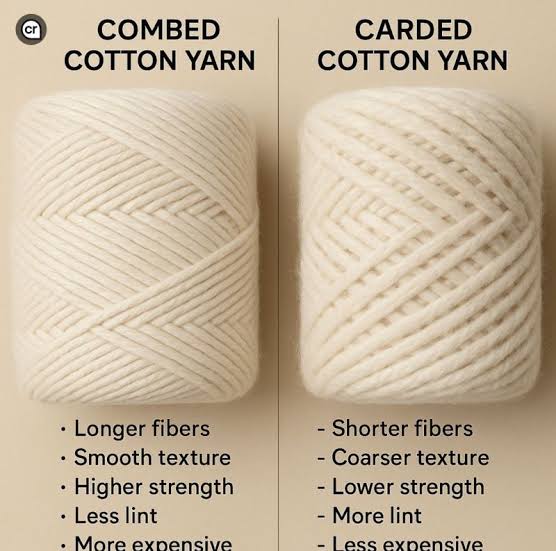
- Carded Cotton (Open-End Cotton): This is your standard, budget-friendly regular cotton. The cotton fibers are cleaned and brushed (carded) to align them in one direction, but short, stray fibers and minor impurities remain. It feels slightly rougher or fuzzier, has a heavier hand-feel, is prone to minor pilling over time, and is ideal for low-cost promotional T-shirts, giveaways, and budget event tees.
- Combed Cotton (Ring-Spun Combed): This is the upgraded, premium version of cotton. After the initial carding process, the cotton goes through fine metal combs that strip away short fibers, dirt, and micro-impurities, leaving only the longest, straightest, and strongest cotton strands. The result is an ultra-smooth, soft, and durable fabric that serves as the best cotton for printing detailed designs, DTG/DTF graphics, and premium apparel lines.
In Short: Use carded cotton when price per unit is your absolute top priority. Choose combed cotton when print quality, customer satisfaction, brand perception, and fabric longevity matter most.
2. What is Carded Cotton? Understanding Standard Raw Cotton
To understand carded cotton, let’s step back into the textile mill. When raw cotton is harvested, it arrives at the mill containing short fibers, long fibers, seed hulls, and dirt particles.
The Carding Process Explained
Carding is the standard first mechanical step in yarn spinning. Heavy wire-brushed rollers untangle the raw, clumped cotton fibers, align them roughly parallel to one another, and remove large pieces of debris. The result is a continuous strand of untwisted fiber called a “sliver.”
In a standard carded cotton T-shirt (often spun using open-end spinning methods), all lengths of cotton fibers—both short stubby bits and longer strands—are spun together into yarn.
Characteristics of Carded Cotton:
- Rougher Texture: Because short, frayed fiber ends stick out along the length of the yarn, the fabric surface feels slightly coarse or scratchy to the skin.
- Fuzzy Surface: The loose micro-fibers create a slight “fuzz” or haze across the knit.
- Higher Pilling Risk: When washed or rubbed against surfaces, those short loose fibers pull out easily, forming annoying little fabric balls (pills).
- Economical Production: Carding requires fewer processing steps and produces less cotton waste, making it significantly cheaper to produce in bulk.
Carded cotton is the standard workhorse fabric of the Indian promo-wear industry. If you’ve ever received a free t-shirt at a marathon or political rally, chances are high that it was made from carded open-end cotton.
3. What is Combed Cotton? Premium Fiber Refinement
Now, what is the true combed cotton meaning, and why do premium fashion brands insist on it?
Combed cotton takes the carded cotton process a major step further. After the raw cotton sliver is carded, it passes through specialized precision combing machines equipped with fine-toothed metal combs.
The Combing Process Explained
The combing machine acts like a fine hairbrush pulling through tangled hair. It performs two crucial functions:
- Removes Short Fibers: It combs out up to 15% to 20% of the shortest, weakest cotton fibers (known as “noils”).
- Aligns Remaining Long Fibers: It arranges the remaining long-staple fibers into precise, parallel lines before they are twisted into yarn using ring-spinning frames.
Characteristics of Combed Cotton:
- Silky Smooth Hand-Feel: Eliminating prickly short ends produces a clean, sleek fabric that feels exceptionally soft against Indian skin, even in humid weather.
- Superior Fabric Strength: Long-staple fibers interlock tightly when spun, creating a yarn with high tensile strength that resists tearing and stretching.
- Zero Fuzz & High Print Clarity: The smooth surface acts almost like high-gloss paper, allowing inks to lie flat and produce razor-sharp edges.
- Minimal Pilling & Shrinkage: Because the short weak fibers were discarded at the mill, the fabric maintains its pristine surface look even after dozens of laundry cycles.
4. Key Differences Table: Combed vs Carded Cotton
Here is a side-by-side comparison matrix highlighting how these two fabrics match up across crucial garment and printing criteria:
| Feature / Criteria | Carded Cotton (Standard Cotton) | Combed Cotton (Ring-Spun Combed) |
| Fibre Length | Mix of short, medium, and long fibers | Exclusively long-staple, uniform fibers |
| Surface Smoothness | Slightly rough, uneven, fuzzy texture | Ultra-smooth, sleek, silky soft finish |
| Fabric Strength | Moderate; higher tendency to stretch/sag | High tensile strength; excellent dimensional stability |
| Pilling Tendency | Moderate to high after repeated washes | Low to virtually zero pilling |
| Print Quality | Good for basic screen prints; poor for fine detail | Outstanding for high-resolution DTG, DTF, and screen print |
| Price Point | Budget-friendly / Low cost | Premium pricing (~15% to 30% higher cost) |
| Target Market | Promo events, giveaways, worker uniforms | Streetwear labels, D2C brands, premium merchandise |
5. Which Fabric is Better for Screen Printing?
Screen printing remains the reigning king of bulk t-shirt customization across India. But when choosing between a combed cotton vs carded cotton T-shirt for screen printing, your choice directly impacts ink performance and production efficiency.
Screen Printing on Carded Cotton
Carded cotton handles standard plastisol ink screen printing quite reasonably, especially for large, bold graphics, block typography, or simple 1-to-2 color vector prints.
However, carded cotton presents specific challenges during screen printing:
- Fibre Bleed-Through: Loose surface fibers can push through thin plastisol or water-based inks, creating a slightly grainy or textured print surface.
- Fibrillation: During flash curing or washing, tiny carded fibers can pop up through the ink layer, making bright white inks look slightly dull or faded.
- Higher Ink Consumption: The porous, fibrous surface absorbs liquid inks unevenly, often requiring extra underbase print strokes.
Screen Printing on Combed Cotton
Combed cotton is universally recognized by master printers as the best cotton for printing via screen printing.
- Glass-Smooth Ink Laydown: Inks sit perfectly flat on the combed surface, allowing halftone dots, gradient blends, and fine lines (down to 0.5pt thickness) to render cleanly.
- Vibrant Color Output: Water-based and Discharge inks penetrate smoothly into combed ring-spun fibers, producing vibrant shades without needing thick, heavy plastisol layers.
- Soft-Hand Print Feel: Because you can use thinner ink layers on smooth combed cotton, the finished print feels soft and breathable rather than like a heavy plastic patch on the chest.
6. Which is Better for Direct-to-Film (DTF) and Direct-to-Garment (DTG)?
Digital printing technologies like DTG (Direct-to-Garment) and DTF (Direct-to-Film) have revolutionized custom apparel in India. If you operate an on-demand t-shirt printing business or print complex multi-color artwork, your fabric selection is non-negotiable.
Direct-to-Garment (DTG) Printing
DTG technology works exactly like an inkjet document printer, but instead of paper, it sprays microscopic droplets of water-based ink onto textile fibers.
- Carded Cotton for DTG (Not Recommended): Avoid carded cotton for DTG whenever possible. Stray fibers create micro-gaps in the white pretreatment layer. When the CMYK color inks are sprayed over, the stray fibers cause ink feathering, fuzzy edges, and a washed-out, dull print image.
- Combed Cotton for DTG (Industry Standard): Combed cotton is mandatory for high-scoring DTG prints. Its tight knit and flat, hairless surface allow the white underbase liquid to form a uniform film. Color drops land with pinpoint precision, yielding photorealistic details, vivid color vibrancy, and superior wash durability.
Direct-to-Film (DTF) Printing
DTF printing involves printing designs onto a PET film, applying TPU adhesive powder, and heat pressing it onto the garment.
- While DTF is generally more forgiving than DTG because the ink sits inside an adhesive film layer, combed cotton still wins hands down.
- On carded cotton, the heat press melts the powder over uneven surface fuzz, which can weaken long-term film adhesion.
- On combed cotton, the film bonds completely flat against the tight weave, preventing premature print peeling or cracking after washing.
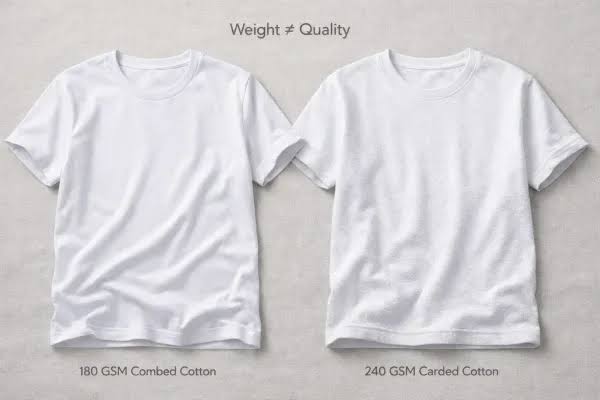
7. Why Two T-Shirts with the Same GSM Can Feel Totally Different
One of the most common points of confusion for buyers and fashion entrepreneurs in India is GSM (Grams per Square Meter). Many people assume that a 180 GSM t-shirt will always feel identical to another 180 GSM t-shirt. That is a myth!
GSM measures only one parameter: weight per unit area. It tells you nothing about yarn quality, fiber refinement, or knitting structure.
Here is why a 180 GSM combed cotton T-shirt feels luxurious, whereas a 180 GSM carded cotton T-shirt can feel stiff, heavy, and rough:
- Yarn Count (Singles): Combed cotton typically uses finer, higher yarn counts (e.g., 30s or 40s singles), meaning the individual threads are thinner and spun tighter. To reach 180 GSM, more fine threads are packed together into a dense, soft knit. Carded cotton often uses thicker, coarser yarns (e.g., 20s singles), resulting in a looser, airier, but rougher structure.
- Ring-Spun Spinning vs. Open-End Spinning: Combed cotton is usually ring-spun, continuously twisting and drafting long fibers into a smooth, compact strand. Carded cotton often uses open-end spinning, where short fibers are bound together by wrapped exterior fibers, creating a bulky but hollow feeling yarn.
- Surface Air Space: Carded yarns trap micro-pockets of air between loose fiber ends, making the fabric feel visually thick but rough. Combed yarns are dense and smooth, offering weight without bulkiness.
Pro Tip for Brands: Never judge a fabric blank solely by its GSM rating! Always request a physical fabric sample to evaluate yarn count, weave density, and surface touch.
8. How to Identify Combed Cotton When Sourcing Blanks
When you’re dealing with wholesale suppliers or inspecting t-shirt samples, how can you verify whether a garment is genuinely combed ring-spun cotton or just regular carded cotton?
Use these 4 quick inspection techniques:
1. The Light / Magnification Test
Hold the fabric up against a bright light source or inspect it under a inexpensive fabric loupe/magnifier.
- Carded Cotton: You’ll notice a light “halo” of fuzzy micro-fibers standing up across the surface. The knit structure looks slightly uneven.
- Combed Cotton: The surface looks clean, smooth, and flat, with crisp visual line patterns and minimal stray fuzz.
2. The Touch and Drag Test
Run your fingertips gently across the inner and outer surface of the fabric.
- Carded Cotton: Feels slightly dry, textured, or scratchy, offering subtle friction as your fingers slide over.
- Combed Cotton: Feels silky, cool, and buttery-soft to the touch with almost zero friction.
3. The Stretch and Recovery Test
Gently pull a section of the t-shirt horizontally and release it.
- Carded Cotton: Low elasticity. It may show slight distortion or take longer to snap back into shape.
- Combed Cotton: High resiliency. The long, tightly twisted fibers spring back instantly to their original shape without sagging.
4. Read the Manufacturer Spec Sheet
Reputable t-shirt suppliers and manufacturers explicitly specify fabric composition. Look for industry tags like:
- “100% Super-Combed Cotton”
- “30s Ring-Spun Combed Cotton”
- “Compact Combed Cotton”
If a spec sheet simply says “100% Cotton” without mentioning “Combed” or “Ring-Spun,” you are almost certainly looking at standard carded open-end cotton.
9. Best Choice by Business Model: Matching Fabric to Your Brand
Selecting between a combed cotton vs carded cotton T-shirt depends on your target audience, pricing strategy, and brand position. Here is how to choose the right option based on your business model:
                  ┌─────────────────────────────────────────┐
                  │    Select Your Apparel Business Model   │
                  └────────────────────┬────────────────────┘
                                       │
            ┌──────────────────────────┴──────────────────────────┐
            ▼                                                     ▼
┌───────────────────────┐                             ┌───────────────────────┐
│     BUDGET / PROMO    │                             │  PREMIUM / D2C / BRAND│
└───────────┬───────────┘                             └───────────┬───────────┘
            │                                                     │
 ┌──────────┴──────────┐                               ┌──────────┴──────────┐
 │ • Promotional Tees  │                               │ • Streetwear Labels │
 │ • Event Giveaways   │                               │ • Corporate Merch   │
 │ • Bulk Campaigns    │                               │ • Print On Demand   │
 └──────────┬──────────┘                               └──────────┬──────────┘
            │                                                     │
            ▼                                                     ▼
┌───────────────────────┐                             ┌───────────────────────┐
│     CARDED COTTON     │                             │     COMBED COTTON     │
│   (Low Cost / Basic)  │                             │  (High Quality/Soft)  │
└───────────────────────┘                             └───────────────────────┘
A. Promotional T-Shirts & Event Giveaways
- Recommended Choice:Carded Cotton
- Why: For single-day corporate marathons, trade show freebies, political campaigns, or mass volunteer events, unit cost is the primary metric. Carded cotton keeps manufacturing costs low while providing a durable, printable 100% cotton canvas.
B. Corporate Merchandise & Startup Team Wear
- Recommended Choice:Combed Cotton
- Why: Corporate swag represents your company’s brand image. Providing employees or clients with a rough, ill-fitting t-shirt that shrinks after one wash reflects poorly on your business. A comfortable 180 GSM combed cotton t-shirt ensures employees will actually wear it proudly outside the office.
C. Streetwear & Indie Fashion Brands
- Recommended Choice:Heavyweight Combed Cotton (200 to 240+ GSM)
- Why: Streetwear consumers in India are extremely discerning about fabric hand-feel, structured drape, and print longevity. Using premium combed ring-spun cotton (or combed French Terry) ensures your drops feel high-end, justify higher retail price points, and build customer loyalty.
D. Premium Everyday Basics
- Recommended Choice:Combed Cotton (30s or 40s Singles)
- Why: If your selling proposition is comfort, breathability, and daily luxury (e.g., solid basic tees, innerwear, lounge tees), combed cotton is non-negotiable. Its buttery texture against the skin is what drives repeat orders.
E. Print-on-Demand (POD) Stores
- Recommended Choice:Combed Cotton
- Why: POD businesses rely on positive online reviews and low return rates. Since POD typically uses DTG or DTF printing, combed cotton guarantees sharp print details, vibrant colors, and long-lasting durability—dramatically reducing customer returns and negative feedback.
10. Frequently Asked Questions (FAQs)
Q1. Is combed cotton 100% real cotton?
Yes, absolutely. Combed cotton is 100% natural cotton. The term “combed” refers specifically to the mechanical refining process used to remove short fibers and align long ones—it does not contain synthetic fibers unless blended with polyester or elastane.
Q2. Does combed cotton shrink in the wash?
While all 100% cotton fabrics experience minor natural shrinkage during initial laundering, combed cotton shrinks significantly less than carded cotton. Because combed cotton utilizes long, tightly twisted fibers, the knit structure remains stable. Pre-shrunk combed cotton blanks offer even greater dimensional stability.
Q3. Which is better for warm Indian summer weather?
Combed cotton is superior for Indian weather. Because the short prickly fibers are combed out, the fabric is smoother, lighter, and more breathable. It allows sweat to evaporate efficiently and doesn’t irritate sensitive skin in hot, humid conditions.
Q4. Is combed cotton more expensive than carded cotton?
Yes, combed cotton is typically 15% to 30% more expensive than standard carded cotton. The price difference accounts for the extra combing machinery process, higher quality raw long-staple cotton, and the loss of ~15% cotton waste combed out during production.
Q5. Can I mix combed cotton with polyester?
Yes! Combed cotton is frequently blended with polyester (e.g., 60/40 or 52/48 CVC blends) to combine the softness and breathability of combed cotton with the wrinkle resistance and quick-drying properties of polyester.
Final Verdict: Which Should You Choose for Your Custom T-Shirts?
When weighing combed cotton vs carded cotton T-shirts, there is no single “wrong” answer—only the right fabric for your specific budget and brand goals.
If you are running a tight-budget campaign where every rupee counts, carded cotton delivers reliable performance at an unbeatable price point.
However, if you are building an online fashion brand, printing high-detail artwork, or creating custom apparel that people will love wearing again and again, combed cotton is worth every extra rupee invested. The superior print clarity, silky hand-feel, and long-lasting durability will elevate your custom t-shirts from ordinary to extraordinary.
See Also
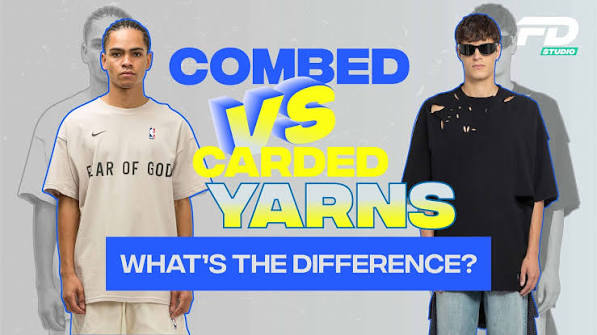
Combed Vs Carded Yarns: What’s The Difference?
Why Combed & Ring-Spun Cotton is Superior
Best GSM for Oversized T-Shirts India: The Secret to Launching a Viral Streetwear Drop
The Overhead Weight Dilemma: Difference Between 180 GSM and 240 GSM T Shirt
How Many T-Shirts Can Be Made From 1 Kg Fabric? GSM, Size and Yield Calculator